Metals and Miners
STEVE HANKE | The Iran war has created a massive supply side shock to the world economy!
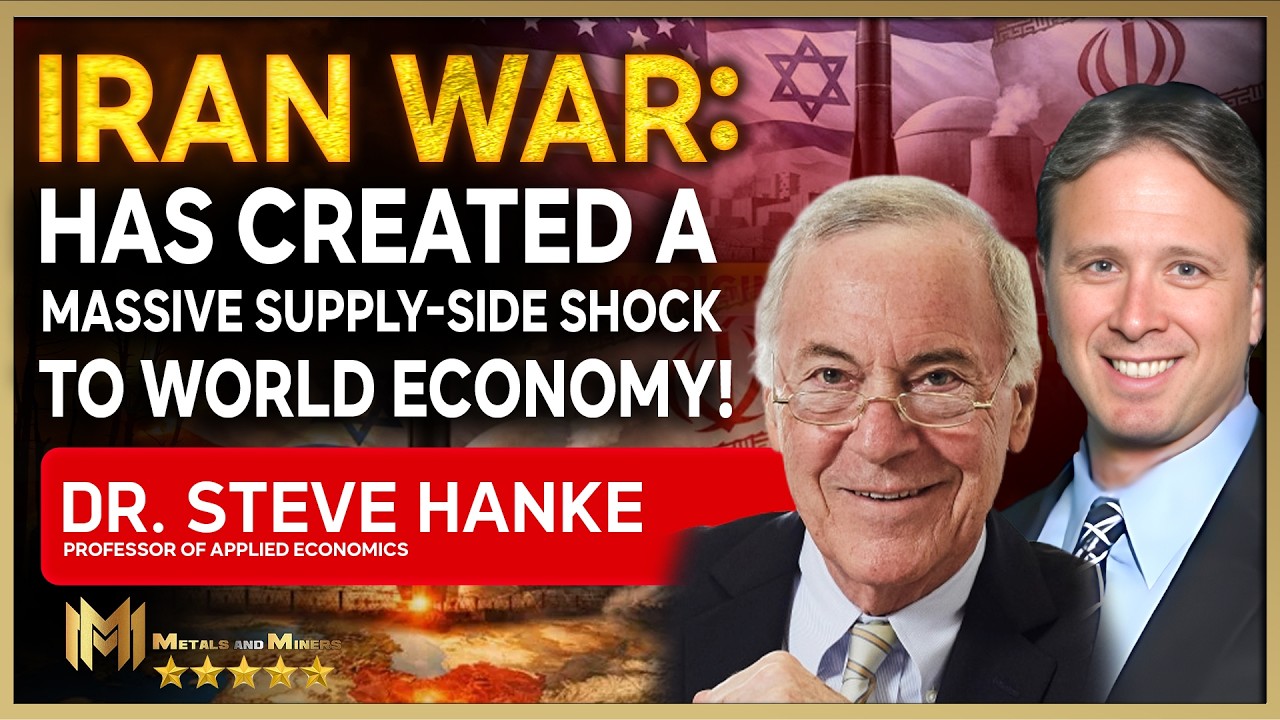
Most Important Insight
The Iran conflict has triggered a structural supply-side shock that renders traditional demand-side monetary tightening ineffective against rising global inflation.
Most Original Insight
Hanke argues that Iran is currently liquidating its shadow gold reserves to fund the war effort, creating a temporary and artificial price ceiling on gold despite hyper-inflationary fundamentals.
Key Points
- The closure of the Strait of Hormuz has effectively removed 20% of global oil supply from the market, establishing a permanent price floor above $120 per barrel through 2026.
- Global shipping costs have increased by 15-20% due to a 'war premium' that affects all physical goods, not just energy commodities.
- Central banks are misdiagnosing current inflation as demand-driven, leading to interest rate hikes that will fail to curb cost-push inflation while crushing industrial output.
- The destruction of Middle Eastern natural gas infrastructure is causing a secondary shock in global fertilizer production, threatening food security for 2027.
- The velocity of money is currently being suppressed by extreme geopolitical uncertainty, which is temporarily masking the true extent of currency debasement.
- Junior gold miners are currently trading at a historic discount to the spot price of gold, representing a massive valuation gap that will close as supply chains stabilize.
Investment Implications
| Asset / Sector / Instrument | Action | Source | Notes |
|---|---|---|---|
| Brent Crude Oil | BUY | explicit | Hanke cites the structural deficit caused by the Strait of Hormuz blockade as a long-term price driver. |
| Gold | BUY | explicit | Recommended as the ultimate hedge against supply-side chaos and the eventual failure of fiat currencies. |
| Junior Gold Miners | BUY | explicit | Hanke identifies these as the most undervalued segment of the metals market relative to underlying asset value. |
| EUR/USD | SELL | implicit | European energy vulnerability and industrial contraction make the Euro a primary victim of the supply shock. |
| US 10-Year Treasuries | SELL | implicit | Rising inflation expectations and the failure of monetary policy to control supply shocks will drive yields significantly higher. |
Hang on a sec…
- Hanke's claim that 'monetary policy is irrelevant' in the face of supply shocks is hyperbolic; while it cannot fix supply, it remains the primary tool for anchoring long-term inflation expectations.
- The prediction of a 'commodity-backed trade bloc' emerging by late 2026 ignores the immense logistical, legal, and trust-based hurdles required to replace the US Dollar-centric financial system.
- Attributing the suppression of gold prices primarily to 'Iran's shadow reserve liquidation' lacks transparent data and may overlook the impact of high real interest rates on non-yielding assets.