RiskReversal Media
Is the S&P 500 A Coiled Spring on its Way Back to 7,000?
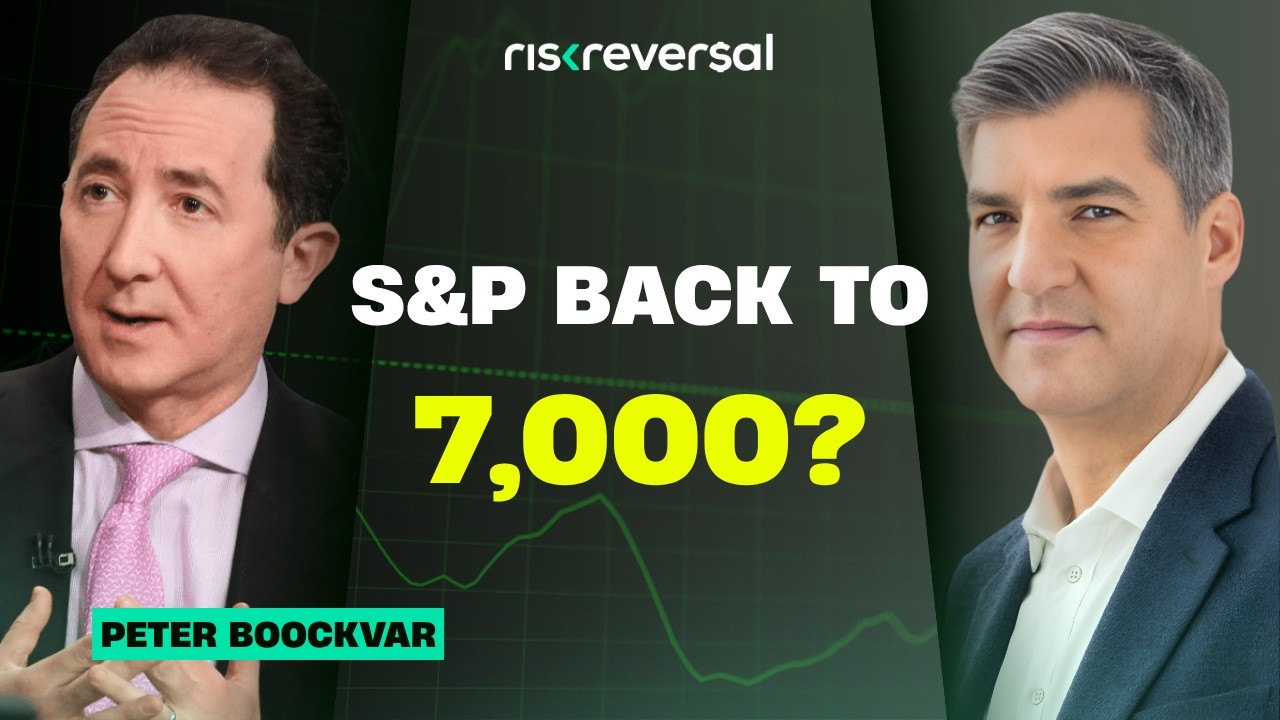
Most Important Insight
The convergence of $120 oil and US 10-year yields approaching 5% creates a critical threshold that will likely force a violent downward repricing of equities and a spike in private credit defaults.
Most Original Insight
Global central banks are shifting from an anticipated 'rate cut' cycle to a 'potential hike' regime in 2026 due to energy-driven inflation spillovers, a pivot that contradicts the prevailing market narrative of a soft landing.
Key Points
- Equity markets are currently exhibiting dangerous complacency toward the widening Middle East conflict and its sustained impact on energy prices.
- The US 10-year Treasury yield is nearing 4.4%, with 4.5% and 5.0% identified as the psychological and mathematical 'danger zones' for equity valuations.
- Sustained oil prices at or near $120 per barrel are projected to trigger a recession by stifling both the housing market and upper-income discretionary spending.
- Private credit markets are showing early signs of systemic stress, with rising default rates among lower-quality, floating-rate borrowers.
- The AI and mega-cap tech leadership that served as the primary market engine is showing clear signs of exhaustion and weakening breadth.
- Central banks in the UK and Europe are seeing record-high yields, signaling that the inflation problem is global and structural rather than transitory.
- Gold is currently undergoing a 'post-parabolic consolidation' phase but remains the preferred long-term hedge against escalating sovereign debt risks.
- The market is operating under a 'delayed repricing' model where geopolitical shocks are ignored until the fundamental economic damage becomes undeniable.
Investment Implications
| Asset / Sector / Instrument | Action | Source | Notes |
|---|---|---|---|
| Crude Oil | BUY | explicit | Prices near $120 are cited as a primary driver of the current macro shift and inflation spillover. |
| Gold | HOLD | explicit | Currently in a consolidation phase, but recommended as a long-term play against sovereign debt risk. |
| Private Credit | SELL | explicit | Boockvar specifically warns of rising defaults among lower-quality, floating-rate borrowers. |
| S&P 500 | SELL | implicit | The index faces a delayed repricing risk as yields approach 5% and mega-cap leadership fades. |
| US 10-Year Treasuries | SELL | implicit | Yields are expected to test 4.5% and 5.0% as central banks pivot back toward potential hikes. |
| Mega-cap Tech / AI Stocks | SELL | implicit | Leadership in these sectors is described as weakening, removing the market's main support. |
| UK and European Bonds | SELL | implicit | Record high yields in these regions suggest further price downside as inflation persists. |
Hang on a sec…
- The title's suggestion of the S&P 500 being a 'Coiled Spring to 7,000' is almost entirely contradicted by the speakers' bearish focus on $120 oil and 5% yields.
- Boockvar's assertion that central banks will pivot to 'potential hikes' in 2026 ignores the historical tendency of banks to pause or ease if the predicted recession actually occurs.
- The claim that upper-income spending is being significantly pressured by current rates lacks granular data in the discussion to distinguish it from the more obvious pressures on lower-income tiers.