The Master Investor Podcast with Wilfred Frost
Greg Peters: Why Sovereign Bonds Now Beat Corporate Credit
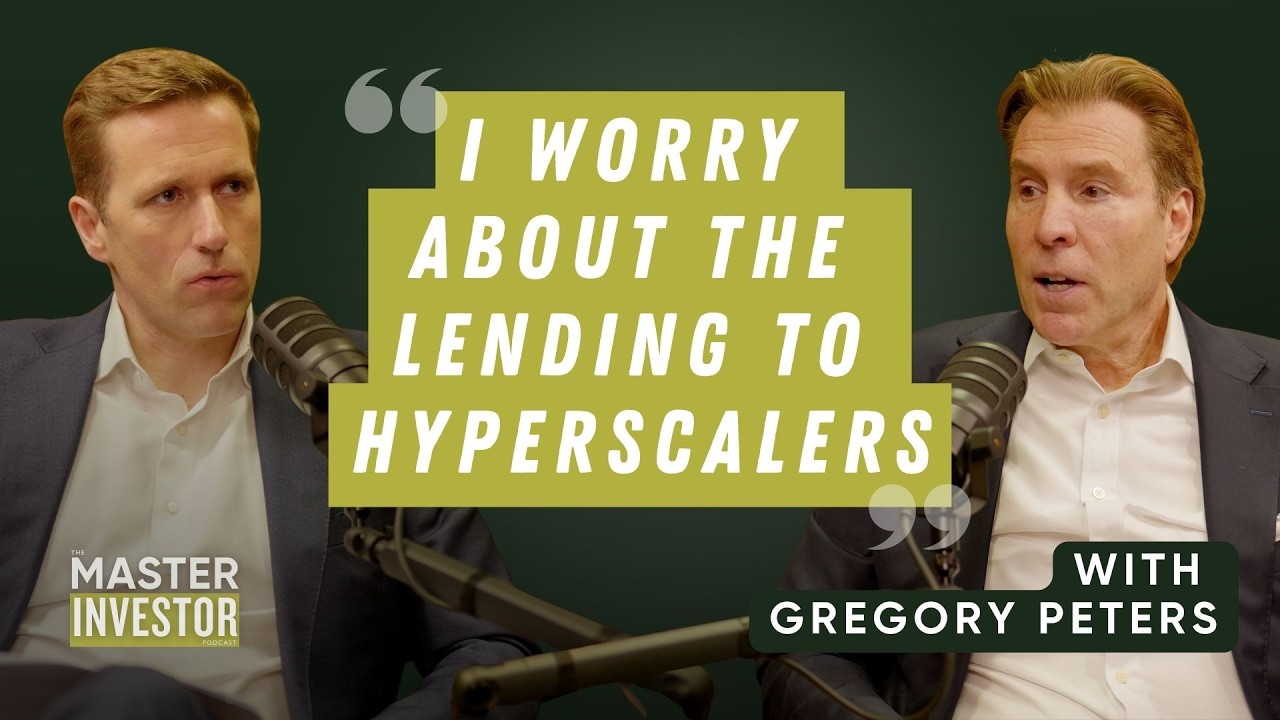
Most Important Insight
Sovereign bonds currently offer superior risk-adjusted value compared to corporate credit because credit spreads have compressed to historical lows while US Treasuries maintain a unique safe-haven status despite upward pressure on long-term yields.
Most Original Insight
Major technology 'hyperscalers' are undergoing a rapid credit profile deterioration, shifting from cash-rich balance sheets to free cash flow negative status by funding massive AI infrastructure through debt and off-balance sheet Special Purpose Vehicles (SPVs).
Key Points
- Credit spreads are at historical lows, providing insufficient compensation for the risks inherent in corporate debt relative to sovereign alternatives.
- The massive capital expenditure required for the AI build-out is forcing previously safe, cash-heavy companies to become significant debt issuers.
- US Treasuries remain the premier global safe-haven asset, outperforming sovereign debt from the UK, France, and Japan in terms of structural stability.
- The long-term trajectory for US bond yields is biased toward the upside due to persistent concerns regarding debt sustainability and growth outlooks.
- Fixed income investors must prioritize free cash flow over growth metrics, as their primary objective is capital preservation and downside protection.
- Duration risk is currently most attractive at the front end of the yield curve, rather than the volatile long end.
- The 'cone of outcomes' for the global economy has widened significantly, necessitating a shift from point-forecast investing to scenario-based modeling.
- Inflation dynamics in the AI era remain a critical and complex variable that requires a humble, non-dogmatic analytical framework.
Investment Implications
| Asset / Sector / Instrument | Action | Source | Notes |
|---|---|---|---|
| US Treasuries | BUY | explicit | Viewed as the superior safe-haven asset with better relative value than corporate credit. |
| Front-end Duration | BUY | explicit | The preferred segment of the yield curve for taking duration risk in the current environment. |
| Hyperscaler Corporate Debt | SELL | explicit | Concerns regarding negative free cash flow and the use of off-balance sheet SPVs for AI spending. |
| Corporate Credit | SELL | implicit | Historical lows in spreads suggest a poor risk-reward profile for credit investors. |
| UK/French/Japanese Sovereign Debt | SELL | implicit | Explicitly identified as less attractive safe-haven options compared to US Treasuries. |
Hang on a sec…
- Peters claims that hyperscalers are 'suddenly' flipping to free cash flow negative, which may exaggerate the impact of AI CapEx relative to the massive, diversified revenue streams and existing cash piles of firms like Microsoft or Alphabet.
- The assertion that AI infrastructure is being significantly funded via off-balance sheet SPVs is a provocative claim that lacks specific evidence or named examples in the discussion, which is unusual for highly transparent public tech giants.
- While arguing for the 'safe-haven' status of US Treasuries, Peters simultaneously warns that the 'direction of travel' for yields is higher due to debt sustainability issues, which creates a logical tension between safety and price risk.